GOODBYE, DOLLY: Remembering the Secular Saint of “Bad Taste” & Good Deeds.
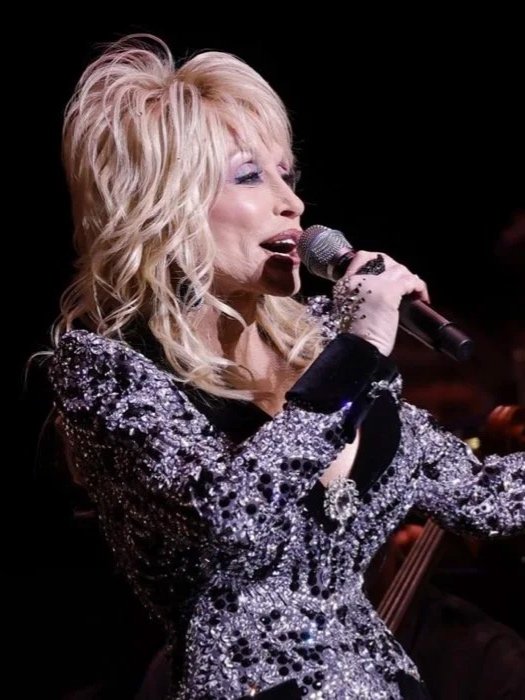
The beloved star passed away at 80 on Aug. 25th.
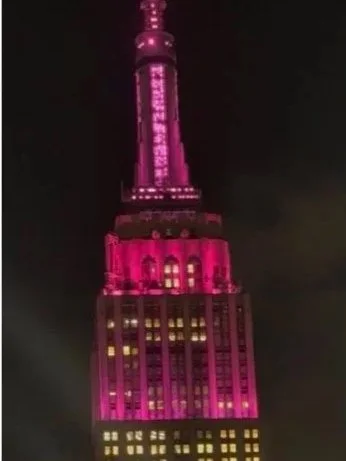
The Empire State Building was lit pink in Dolly’s honor on Tuesday, August 25th.
At 9:25PM Tuesday (“9 to 5”), the Empire State Building was ablaze in pink lights in memory of Dolly Parton, who died earlier that day at age 80. And it felt only right to travel the 150+ blocks downtown to convene with the thousands of others looking up at that storied spire in a silent prayer, “RIP, Dolly.”
Why did it mean so much to me? The answer lies in fully understanding just what Dolly meant to the world. Not an easy task. From “9 to 5” being played at the Changing of the Guard outside Buckingham Palace to the Tennessee state rep vowing to introduce a bill to rename Nashville’s airport after her, the last 48 hours have confirmed what we already knew: To the world, she was family. But the many contradictions she embodied and the norms she challenged speak to a profound legacy much harder to verbalize.
I found myself reflecting on Dolly’s appeal in earnest in 2021, when a friend reached out on behalf of the owner of ENVY Wigs, Alan Eaton. The Indianapolis-based company had been approached by Dolly’s “people” about a possible licensing deal with QVC—and I was asked to develop a marketing position and strategy, which said in part:
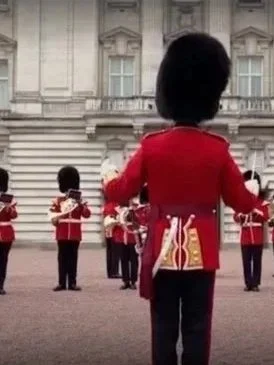
The Royal family paying tribute to Dolly with a rendition of “9 to 5”
In these divided times, “One of the few things everyone still seems to agree on is Dolly Parton,” noted Jad Abumrad, host of the WNYC Studio Podcast, “Dolly Parton’s America.” The eight-time Grammy Award winner’s universal appeal is seemingly unmatched, with Abumrad noting the “evangelical church ladies standing next to men in drag standing next to guys in trucker hats“ at her concerts. With “Dolly Parton’s America” and Netflix’s 9-part series, “Dollyverse,” her cultural relevance is stronger than ever—as is her cult- like appeal to numerous communities, “on either side of the culture wars.”
In the end, the “financials” didn’t make sense, but the assignment did result in my being hired as ENVY’s Chief Marketing Officer, where I remained for 2+ years. While Dolly’s relevance and appeal remained until her death. And are sure to grow after it.
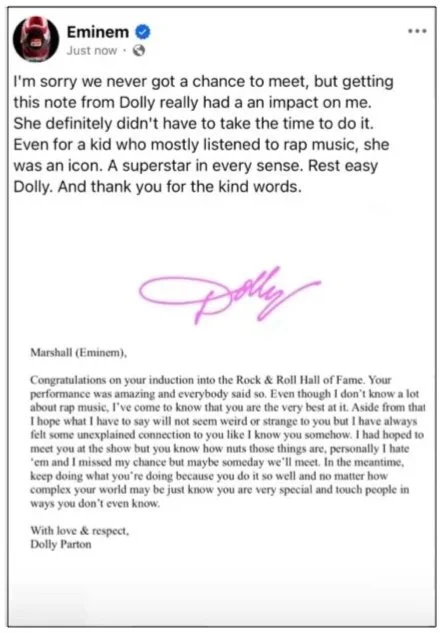
Eminem was a fellow Rock and Roll Hall of Fame inductee in 2022 (along with Lionel Richie, Duran Duran, Pat Benatar, Eurythmics, Carly Simon, and Judas Priest)
Naturally, social media has been flooded with tributes from fellow artists—many of whom opened recent shows with a tribute to Dolly. Reba and Brandi Carlile, sure. But also John Mayer, Post Malone, Harry Styles, Snoop Dog, and Pitbull, who sampled "9 to 5” in his 2024 collaboration with Dolly, "Powerful Women" and dedicated his show, “To all the powerful women here tonight… but more than anything to the legend that will live forever." The level of reverence is not surprising—though the breadth of genres might be. And no post moved me more than Eminem’s—in which he shared a fax he’d received from Dolly (below) after the two were inducted into the Rock and Roll Hall of Fame.
Marshall (Eminem),
Congratulations on your induction into the Rock & Roll Hall of Fame. Your performance was amazing and everybody said so. Even though I don't know a lot about rap music, I've come to know that you are the very best at it. Aside from that 88 I hope what I have to say will not seem weird or strange to you but I have always felt some unexplained connection to you like I know you somehow. I had hoped to meet you at the show but you know how nuts those things are, personally I hate 'em and I missed my chance but maybe someday we'll meet. In the meantime, keep doing what you're doing because you do it so well and no matter how complex your world may be just know you are very special and touch people in ways you don't even know.
With love & respect,
Dolly
Vulnerable in her admission of their unexplained connection. Conspiratorial in her dislike of award shows. Even a little maternal. The raw affection Dolly’s shows for her fellow inductee is surprisingly moving. (As is his heartfelt response to it.) That Dolly (a country artist) was inducted is in itself a testament to her unique place in music —and initially, she had tried to respectfully decline the nomination. It was only after learning the institution recognizes a broader definition of musical impact, that she embraced the honor, famously stating at the event, "I'm a rock star now!"
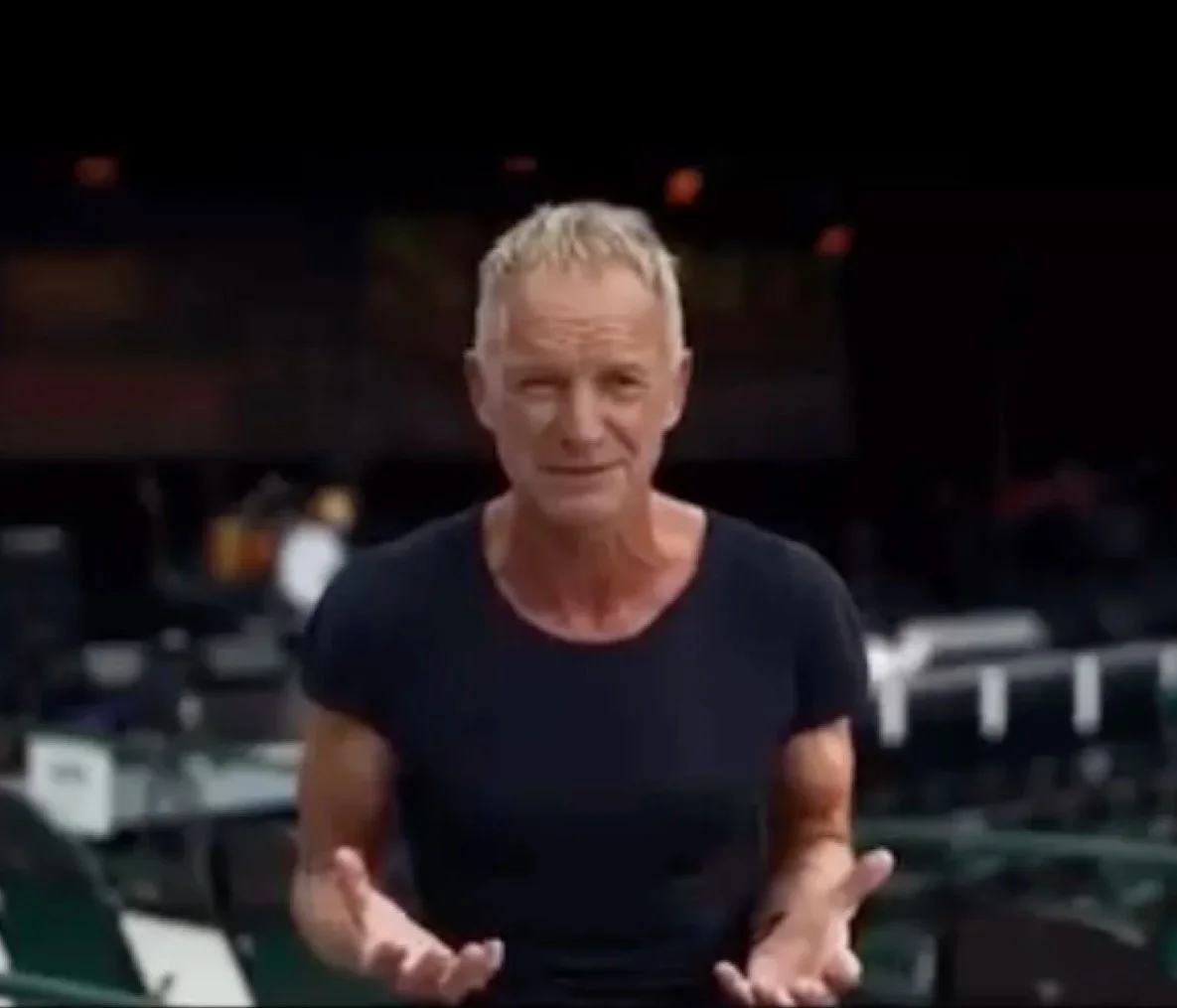
Such humility combined with wide-eyed enthusiasm might seem cloying if it weren’t so authentic. So Dolly. So unlike rock music’s usual self-important poseurs. And how great was it to see Dolly inspire those same emotions in an artist like Sting, who spoke with immense wonder, reverence, and charm about being asked to record a duet of his iconic 1983 hit "Every Breath You Take" with Dolly for her 2023 rock-inspired album, Rockstar. "When Dolly asks you to do something, you don’t even consider it. You just say, 'Yes, ma’am.' Because she’s a legend," he said. And it was her legendary talent as a songwriter that humbled him most. “She’s not just an icon, she’s one of the most successful songwriters in America. So for her to choose your song… that pedigree… it means a great deal.”
“Writing’s just as natural to me as getting up and cooking breakfast,” Dolly once said—her words belying a craft that has produced over 3,000 songs . Her catalog is one of compassion—whether for the poor child (“Coat of Many Colors”), the pregnant unmarried girl (“Down From Dover”), the mother nobody really sees (“To Daddy”), or the pilgrim-as-everyman in “Travelin’ Thru” (written for the 2005 film, Transamerica):
God made me for a reason and nothing is in vain
Redemption comes in many shapes with many kinds of pain
Oh sweet Jesus if you're listening, keep me ever close to you
As I'm stumblin', tumblin', wonderin', as I'm travelin' thru
Employing the simple language of her Appalachian roots, her lyrics are “concise, open and almost instantly familiar,” noted one New York Times’ critic. “Sympathetic yet utterly clearheaded.” Dolly’s empathy and refusal to pass judgement isn’t incidental to her lyric writing—it’s essential. With the morals of the public Dolly and the songwriting Dolly being one and the same.
Also trending on social media is the phrase "we said Donny not Dolly," as fans wish a less-beloved public figure had been taken instead. Such sentiment would be anathema to the famously non-political Dolly—and I’m wary of repeating it here. Yet it is within the context of these times that we see just how singular and unifying a personality she was.
The man who regularly turns eulogizing into personal vendettas—who couldn’t mark the deaths of Rob and Michelle Reiner without remarking that the “TRUMP DERANGEMENT SYNDROME [that afflicted the director] had reached new heights as the Trump Administration surpassed all goals and expectations of greatness”… who declared, “I'm glad he's dead,” when news of Robert Mueller's death was announced in 2026—ordered U.S. flags nationwide to be flown at half-staff for one-week in Dolly’s honor (stating "there has never been anyone like her, and never will"). It is one of the few times (if not the only one) that the President has spoken of a public figure on Truth Social with real affection—and not used the platform to right some perceived wrong.
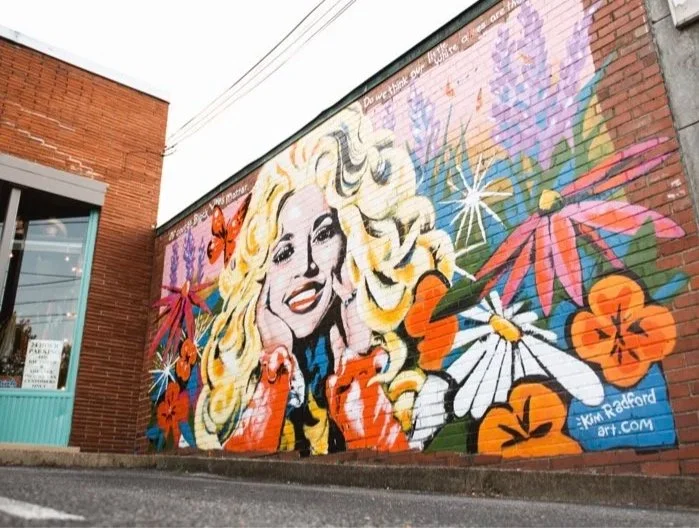
Dolly’s support of the Black Lives Matter movement led to the 2020 dedication of a mural by artist Kim Radford in Nashville.
It would have been easy to, considering she twice turned down Trump’s Presidential Medal of Freedom (citing her husband’s illness the first time, and COVID-19 the second). But Dolly turned down a similar overture from the Biden administration, firmly cementing her stance to avoid political favoritism. Dolly's political neutrality was something she could joke about. "My daddy was a Republican, my mama was a Democrat, and I’m a hypocrite!" she famously quipped, pronouncing "hypocrite" as "hypo-crat" in her iconic Tennessee drawl.
But that didn’t keep Dolly from using her platform to support the Black Lives Matter movement during the height of the George Floyd protests in 2020, stating, “I do understand people having to make themselves known and felt and seen. And of course Black Lives Matter. Do we think our little white asses are the only ones that matter? No, everybody matters.”
And it didn’t stop her from donating $1 million to COVID-19 vaccine research (which aided in the development of the Moderna vaccine), while the President knowingly downplayed the pandemic. Dolly even received the vaccine on camera to encourage the public to get immunized, singing a playful take on her hit song "Jolene" ("Vaccine, vaccine, vaccine, vaccine, I'm begging of you please don't hesitate").
Dolly seemed unique in her ability to navigate polarizing issues in the most divisive of times while remaining immune to being cancelled! It’s no wonder that her ability to unify people who could agree on nothing else—combined with a nonjudgmental public persona that seemed otherwordly—should, in death, make her feel like an American secular saint.
Such universal adulation is SO rare that I suspect journalists will be challenged to arrive at a quick verdict re: her legacy. Touching on gender, class, celebrity, Southern identity, authenticity, and performance, Dolly’s persona is worthy of the kind of serious intellectual examination we associate with Susan Sontag, the novelist and “cultural critic” whose famous 1964 essay “Notes on ‘Camp’" examined artifice and stylization. The complicated relationship between seriousness and frivolity. Mass culture and the marginalized. Contradictions… of which Dolly had many.
Dolly embodied the male fantasy of femininity—AND owned the economic machinery behind it. She proved that authenticity and artificiality aren't necessarily opposites—making every moment emotionally true through a constructed persona of big hair, nails and rhinestones. Bored by our notions of “class,” she deliberately embraced "bad taste.” She didn't try to be culturally respectable in order to achieve success. She made the traditionally “vulgar” iconic. And left us to marvel at how a woman who embodied so many things the elite look down on—country music, Appalachia, huge breasts, wigs, rhinestones, sentimentality, theme parks, conspicuous wealth, "tacky" taste—could become one of the few people sophisticated America is almost embarrassed not to admire!
Complicated stuff, indeed. And not easily unpacked. But the lessons Dolly gave us by simply living are profoundly simple. And we can honor her by heeding them.
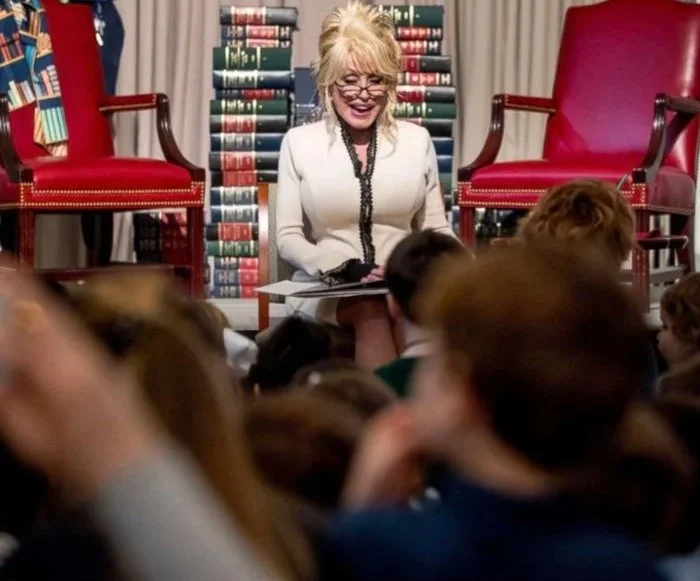
Reading her book "Coat of Many Colors," to mark the 100 millionth book donated by her Imagination Library charity. (Feb. 27, 2018)
As a vocal supporter of the LGBTQ+ community, she taught us a lesson in inclusion and family—advocating for unconditional love and acceptance (despite the backlash from religious groups over refusing to condemn queer people).
Seeing how her father’s inability to read prevented him from fully chasing his dreams, Dolly created the Imagination Library in his honor, mailing one free, age-appropriate book every month to children from birth until they turn five. This lesson in charity was given a very human face when I saw a post from a gay father recalling the adoption of his two sons over twenty years ago. “There were no baby showers, and they didn’t get any gifts, any toys, anything. People didn’t approve of it. But what we did get was a book every month for our sons for the first few years of their lives. And when they got old enough to realize they were getting a book from Dolly, it became a monthly tradition to go to the mailbox and see if their book had come yet.”
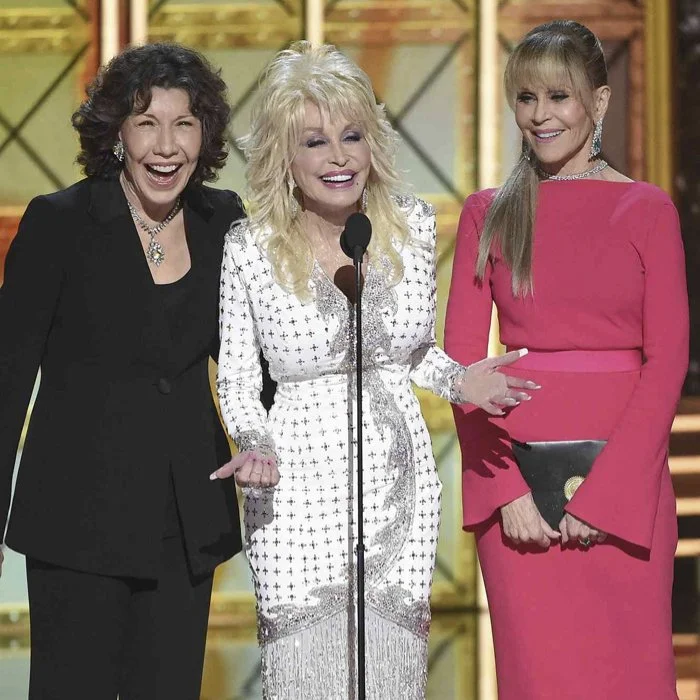
With her “9 to 5” co-stars at the 2017 Emmy Awards.
In a world that seems to reward outrage—where nasty comments get more likes and online anonymity make people feel free to attack—it’s nearly impossible to find an instance of Dolly speaking maliciously about anyone! Her niceness wasn't naïve. It was a choice. And a lesson in kindness. Over her 60-year career, Dolly faced egos and exploitation, and often described having to fend off sexual advances. Yet she never named or publicly humiliated the offenders. “I'm not God, I'm not the judge. I love people and I don't judge anybody.” That attitude is—in part—a product of being judged because of the way she looked. Her tolerance was more than the standard Christian rhetoric—and again, uniquely hers: Being dismissed as cheap or dumb helped cement her determination not to do the same thing to others.
When Beyonce’s “Cowboy Carter” album stirred debate among traditionalists, Dolly championed her entry into country music, especially praising the singer’s empowered remake of her classic hit "Jolene.” And when people lined up to condemn Miley Cyrus (Dolly’s goddaughter) during her controversial post-Hannah Montana period, Dolly explicitly said, “You'll never hear me say anything bad about Miley,” (emphasizing the young woman’s intelligence and talent instead). This doesn't mean she was incapable of criticism—which was quick and pointed. When discussing the decision to remove “Dixie” from Dollywood’s Dixie Stampede, she acknowledged that people used it due to “innocent ignorance,” but said that once you understand something is hurting people, you fix it: “Don't be a dumbass.”
Such anomalies aside, by consciously choosing non-condemnation, Dolly embodied yet another contradiction: she was a woman with enormous cultural power who refuted one of the conventional uses of power—the ability to publicly diminish others.
“She was simultaneously a naughty, playful southern gal from the hollows of Tennessee and a deep, soulful thinker who could see through people right down to their true selves.”
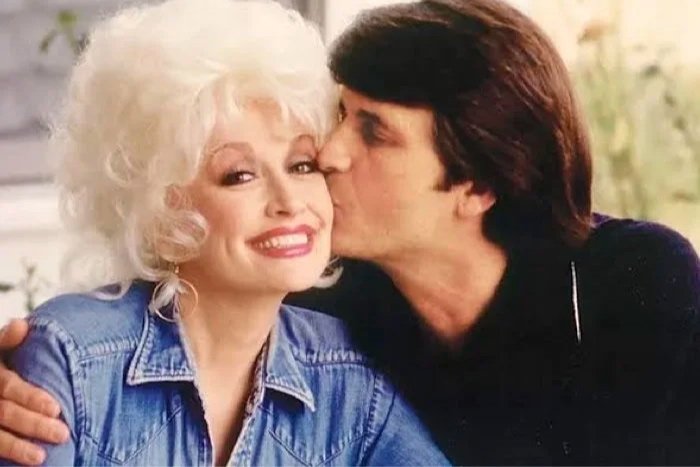
Dolly credited her 59-year-long marriage to Carl Dean (who died in March, 2025) to a shared sense of humor and his complete lack of jealousy regarding her fame.
A secular saint? A walking ministry? No doubt Dolly would poo-poo such labels. As would Sontag, who was wary of sentimentality and the way culture turns complicated people into comforting symbols. Dolly often noted that she was far from saintly or self-righteous—she enjoyed sinning too much to claim perfection. Her mission was simply to make people happy, lift others up, and express her personal faith without putting herself on a moral pedestal. It’s an extraordinarily difficult thing to remain generous toward people without appearing naïve or sanctimonious. To be both “formidable” and “floozie”—yet not attract the ire of either sex (for generations). And upend the gamut of female archetypes in the process. But Dolly Parton did it. Every day of her life.
There will never be anyone like her. But think how better the world would be if each of us—even a little—tried to be.
“Find out who you are and do it on purpose.”